After 40, many couples find themselves facing a misunderstanding nobody expected. She gets tired more quickly, reacts more sensitively, sometimes avoids closeness. He becomes more withdrawn, talks less, seems to be pulling away. Both feel misunderstood. And sometimes alone, too. Yet very often this is not a relationship crisis. It is hormonal change happening in both partners at the same time. And once we understand that, everything looks different.
What happens in a woman’s body: perimenopause and the role of oestrogen
Perimenopause – a period that can last 4–10 years before the last period – begins on average at around 44–46 years of age. During this time oestrogen and progesterone levels fluctuate unpredictably, causing a wide range of symptoms.
Oestrogens affect more than the reproductive system. They take part in:
- Regulating serotonin and dopamine – which is why mood and emotional sensitivity change
- Thermoregulation – hot flushes are a direct result of falling oestrogen levels
- Sleep architecture – progesterone has a calming effect; as it decreases, sleep quality worsens
- Cognitive function in the brain – memory, concentration, brain fog
- The hydration and structure of mucous membranes – intimate discomfort
- Bone density and muscle tone
It is important to understand: when a woman becomes more sensitive, tires more quickly or avoids closeness, this is usually not a “change of character”. These are signs of an imbalance in the nervous system and hormones, with a biological basis.
What is andropause: declining testosterone in men
Andropause is the gradual decline of testosterone levels in a man’s body, usually starting after the age of 40–45. Unlike menopause, this process is slow – around 1–2% a year – so it often goes unnoticed for a long time.
Testosterone is not just a “sex hormone”. It regulates:
- Energy production and physical stamina
- Muscle mass and strength – a lack of testosterone accelerates sarcopenia
- Dopamine systems – motivation, initiative, joy
- Cognitive function – concentration and decision-making
- Emotional regulation – irritability and stress tolerance
- Recovery after physical and emotional strain
When testosterone declines, men often become quieter, less inclined to talk about how they feel and emotionally withdrawn. This is often misread as indifference or a cooling of the relationship. In reality it may be a change in the hormonal and neurological background.
An established fact: chronic stress and lack of sleep can reduce testosterone by 15–20% – even without the age factor. This means that many men experience andropause earlier and more severely because of their lifestyle.
When both change at the same time: what this means for a couple
Here lies the essential point that is rarely talked about: menopause and andropause often coincide in time. A couple aged 45–55 is statistically very likely to be going through both processes at once.
A typical scenario:
- She – perimenopause: heightened emotional sensitivity, fatigue, intimate discomfort, hot flushes at night
- He – andropause: reduced motivation, emotional withdrawal, slower recovery, lower libido
Both feel different from before. Both look for reasons. And both often find them – in each other. Conflicts, drifting apart, failing to communicate – often this is not a relationship problem. It is two people struggling with changes inside themselves, without the context to understand what is really going on.
How these changes affect intimacy
Intimacy changes after 40 – and that is normal. But understanding why matters a great deal:
- On her side: dryness of the mucous membranes (because of a lack of oestrogen), reduced libido (because of a change in the balance of testosterone and oestrogen), heightened sensitivity, fear of discomfort
- On his side: a slower sexual response (a normal physiological change), less initiative (reduced activity of dopamine systems), sensitivity to rejection
When both of these processes happen at the same time and are not discussed, a couple may start to avoid closeness altogether. Not because love has gone. But because bodies are changing and nobody is talking about it.
What can be done: support for both
For her
- Supporting the mucous membranes from within – hyaluronic acid, slippery elm, fermented ginseng, maca
- Stabilising the nervous system – adaptogens, improving sleep quality
- Reducing cortisol levels – yoga, walks, stress management practices
- Regular movement – supports oestrogen metabolism and mood
For him
- Enough protein – supports testosterone production and muscle mass
- Strength training – one of the most effective natural ways to support testosterone
- Sleep – testosterone is produced mostly during deep sleep; a lack of sleep lowers it directly
- Reducing stress – cortisol and testosterone are antagonists: as one rises, the other falls
- Zinc and vitamin D – trace elements directly linked to testosterone production
For the couple together
- Understand that both of you are changing – and that it is not each other’s fault
- Talk about it – even if it feels awkward; knowing reduces fear and blame
- Move together – shared physical activity lowers cortisol for both and strengthens the bond
- Lower your expectations of yourself and of each other – this stage calls for more space, not more effort
Frequently asked questions
Is andropause real? Some people say it does not exist.
The term “andropause” is debated in medicine, but the phenomenon itself – testosterone declining with age – is scientifically confirmed. It is also called PADAM (partial androgen deficiency of the aging male) or LOH (late-onset hypogonadism). The symptoms are real, even if the process is slower and less dramatic than in women.
How do you know whether it is hormones or relationship problems?
A good question – and the answer is not always clear. If the symptoms (fatigue, mood swings, changes in libido, sleep) appeared gradually and fit the changes of this age group, a hormonal cause is very likely. If conflicts existed before as well, both causes are possible. In either case it is worth checking your hormone levels and, if needed, seeing a couples counsellor.
Does it need treatment?
Not all hormonal changes require medication. Many couples come through this period successfully by changing their lifestyle, using natural support and talking to each other. But if the symptoms are severe, a hormone test and a doctor’s consultation are always worthwhile.
Find more answers in our FAQ section →
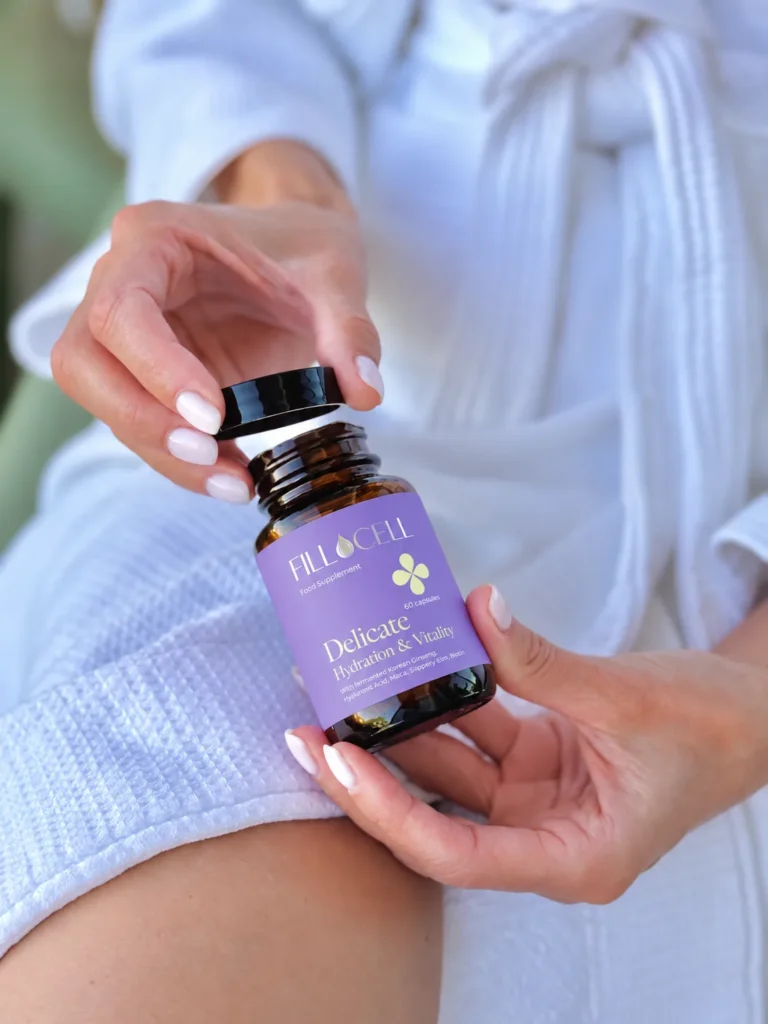
FILLaCELL Delicate Hydration & Vitality: support for her
FILLaCELL Delicate Hydration & Vitality was created with the needs of a woman in perimenopause in mind. The formula combines:
- Hyaluronic acid – supporting the moisture of mucous membranes from within
- Slippery elm (Ulmus fulva) – traditionally used to soothe mucous membranes
- Fermented ginseng – adaptogenic support, energy, hormonal balance
- Maca (Lepidium meyenii) – studied for supporting libido and energy
- Biotin – supporting tissue structure
It is everyday support for a woman whose body is changing – gently and consistently.
Discover FILLaCELL Delicate Hydration & Vitality →
After 40 we all change. The question is not “how do I go back to how it was” but how to understand what is happening now and find a new balance – both in yourself and together.