After age 40, many women notice that their hair is thinning: more hair remains on their combs, and their hairstyles no longer have the same volume as before. Test results are often normal, but there is no clear answer as to why this happens.
In this article, we’ll explain in simple terms how hair grows, why it might fall out, what you should discuss with your doctor, and what nutrients your hair needs.
The Three Phases of Hair Growth
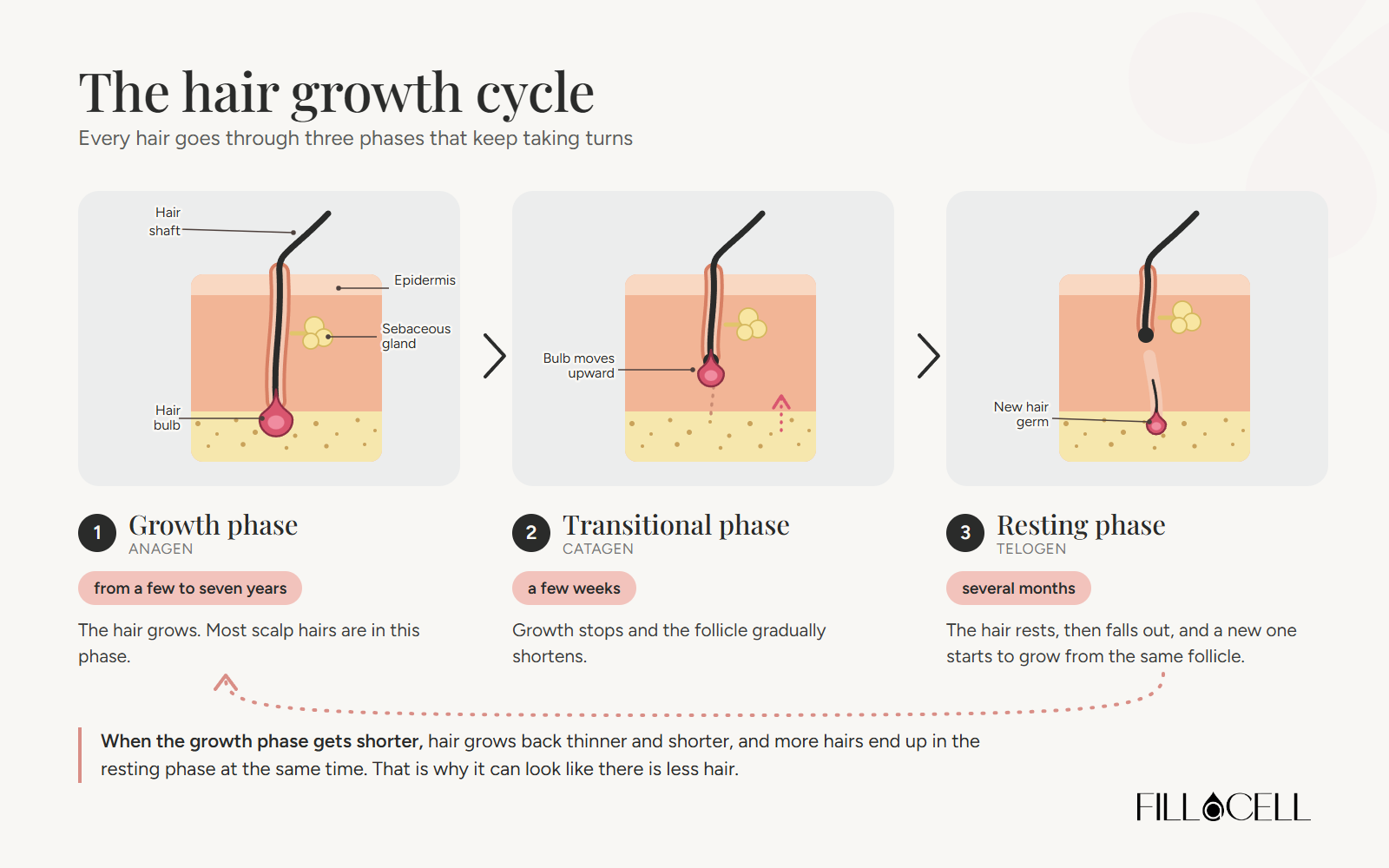
Every hair goes through cycles:
- Growth phase (anagen). Hair grows for anywhere from a few to seven years. Most of the hair on the head is in this phase.
- Transitional phase (catagen). Growth stops. This phase is brief and lasts a few weeks.
- Resting phase (telogen). A hair rests for several months, then falls out, and a new one begins to grow from the same follicle.
Therefore, it is normal to lose a few dozen hairs every day. You should be concerned if you lose more than usual or if new hair is growing in thinner.
Why Does Hair Fall Out?
When hair falls out, there is usually more than one cause.
Hormonal fluctuations. During perimenopause, estrogen levels fluctuate and gradually decline. It is believed that estrogen helps prolong the hair growth phase, so when estrogen levels drop, this phase may become shorter.
Sensitivity to androgens. A woman’s body also contains male hormones, known as androgens, albeit in small amounts. One of these is DHT (dihydrotestosterone). As estrogen levels decline, the influence of androgens becomes relatively greater. Follicles that are genetically more sensitive to androgens react more strongly: the growth phase shortens, and the hair that grows back is thinner, shorter, and duller. As a result, it appears as though there is less and less hair, even though the follicles are still present.
Stress Prolonged or severe stress can cause more hair to enter the resting phase, and hair loss becomes noticeable only after a few months.
Nutrition. Hair is mainly composed of the protein keratin, so it needs sufficient amounts of protein, amino acids, and minerals.
Other factors. Iron deficiency, thyroid disorders, certain medications, illnesses, and childbirth.
What tests should you discuss with your doctor?
If you’re losing more hair than usual, talk to your family doctor. The following tests are most commonly discussed:
- complete blood count,
- ferritin (iron storage),
- the thyroid-stimulating hormone (TSH),
- vitamin D and vitamin B12,
- sometimes sex hormones.
Your doctor will decide which tests are necessary based on your symptoms. If you experience sudden hair loss, patchy hair loss, or hair loss accompanied by other symptoms, see a doctor as soon as possible.
You can read more about the causes of hair loss on the British National Health Service (NHS) website.
What’s Important for Your Hair
A balanced diet. Make sure to eat enough protein, a variety of vegetables, nuts, and seeds every day.
Sleep and Stress. Regular sleep and at least a few quiet minutes each day help the body relax.
Scalp massage. Every day, gently massage your neck and the entire scalp with your fingertips for 3–5 minutes. Massage can stimulate blood circulation in the skin, and it’s also a pleasant evening ritual.
Silk pillow. Silk causes less friction on the hair than cotton and absorbs less moisture, so your hair experiences less friction while you sleep and stays softer. Read more about daily habits in the article “Hair Care After 40.”
What is in Hair Rebalance?
Hair Rebalance is designed for women aged 35 and older, as we approach perimenopause, and is formulated with ingredients that are essential for healthy hair.
Zinc, selenium, and copper. Zinc and selenium help maintain normal hair, while copper helps maintain normal hair pigmentation. All three also help protect cells from oxidative stress. We use zinc and copper in the form of bisglycinates—that is, bound to the amino acid glycine—and these forms may be more easily absorbed by the body.
Hydrolyzed keratin. Plaukai daugiausia sudaryti iš keratino, todėl į formulę įtraukėme paties keratino. Hidrolizuotas reiškia, kad jis jau suskaidytas į smulkias dalis.
L-cysteine, L-methionine, and L-lysine. These are amino acids, the building blocks of proteins. Cysteine and methionine contain sulfur, and keratin is a protein particularly rich in sulfur, which is why we chose these amino acids intentionally.
Bamboo shoots. Bamboo is one of the strongest yet most flexible plants in the world, and its strength comes from silica. Bamboo shoots are a natural source of silica. Silica is a trace element also found in our bodies, specifically in connective tissues. That is why it is in our formula: we wanted a natural source of silica alongside amino acids and minerals.
Fermented green tea (caffeine-free). Green tea leaves contain polyphenols, including catechins. We use a fermented extract in our formula. Fermentation changes the plant’s nutrient composition, making it easier for the body to absorb. The extract is caffeine-free, so it is suitable for use at any time of day.
Nettle leaves. Nettle is one of the oldest plants used by humans in Europe and Asia. Its leaves are rich in minerals, such as calcium, as well as carotenoids and other plant compounds. Therefore, we chose it as a natural plant rich in minerals and botanical compounds.
Saw Palmetto (Serenoa repens). This is a palm tree whose dark berry extract consists mainly of fatty acids and small amounts of plant sterols, such as beta-sitosterol. Saw palmetto is included in the Hair Rebalance formula as an exceptional raw material important during periods of hormonal change.
Take 2 capsules of Hair Rebalance daily. Evaluate results after at least 3 months, as the hair cycle is slow. Like other dietary supplements, it is not a substitute for a balanced diet and a healthy lifestyle.
A dietary supplement is not a substitute for a varied diet. A diverse and balanced diet is important.